CA
 US



pest bird control
-
Falconry Based Bird Control
Falconry-based bird control is a sophisticated and environmentally responsible method of managing nuisance bird populations. In Canada, this process is mainly used for gulls and pigeons. It leverages the natural hunting instincts and behaviours of birds of prey to deter, scare, or sometimes remove smaller birds that pose economic or health-related issues in various settings. This form of bird control is increasingly preferred over more traditional methods, such as the use of poisons, nets, or noise-making devices, which can be less effective, more intrusive, and potentially harmful to the environment and non-target species. Here are some main points to help you understand the history, process, application, and benefits of falconry-based bird control. We will also dive into the main locations that falconry-based bird control is commonly used.
1. Historical Context and Evolution
Falconry, the practice of training raptors to hunt, dates back millennia and is a tradition that has been passed down through generations and across many different cultures. The adaptation of falconry for the purpose of bird control is a relatively recent development. As society evolves and many areas once populated by forest become increasingly more inhabited by businesses and homes, the need for more humane and ecological methods of managing wildlife populations has become a necessity. Falconry, once used only for sport, has become a practical and effective solutions for many.
2. Training and Falconer Expertise
The success of falconry-based bird control hinges heavily on the expertise of the falconer and the training of the birds. Falconers must have a deep understanding of raptor behaviour, bird ecology, and the specific dynamics of the nuisance species they are trying to control. Birds of prey are trained through a process that involves trust-building, learning commands, and conditioning the birds to work in various environments. Falcons, hawks, and sometimes even eagles are taught to work in cooperation with a falconer to fly over problem areas and sometimes predate on nuisance bird species using a technique called ‘kill-to-scare’; although not always necessary. Knowing which falconry bird species would be most effective for your bird control problem is the key to success in this arena. For example, birds that typically predate on ground animals may not be as effective in scaring away or predating on nuisance birds. These factors are up to the falconer to decide in order to provide the best service possible.
3. Raptors in Bird Control
Different species of raptors (birds of prey) are chosen based on their suitability to the environment and the target pest species.
Falcons (e.g. Peregrine Falcons, Gyrfalcons)
Known for their incredible speed and agility, they are often used in open areas or in settings where their high-speed hunting flights can deter other birds. Peregrine Falcons will typically capture their prey mid-air. The prey of the peregrine falcon solely consists of bird species, although the size can range from small song birds all the way to large geese and other shore birds. The Gyrfalcon varies slightly in the sense that they will typically knock prey down while flying and then gather them on the ground. In addition a Gyrfalcon will also predate on ground mammals such as hare.
Hawks (e.g. Harris's Hawks, Red-tailed Hawks)
Known for their ability to navigate through more enclosed spaces, they are ideal for hunting in urban environments or agricultural settings. These birds are known for perching and gliding down to capture prey with their talons. With very similar diets, these hawks typically predate on rabbits, rodents, and other birds; even up to the size of a pheasant. Red-tailed Hawks and Harris’s Hawks do differ somewhat in their hunting ability. For example, Red-tailed Hawk’s are more keen at capturing say a squirrel in a tree. These slight differences in hunting ability can make all the difference when choosing what bird of prey will be used for each particular situation.
Eagles (eg.Golden Eagle, Bald Eagle)
Although less commonly used due to their size and the nature of their hunting, Eagles can be effective in certain situations where larger birds need to be controlled. In the wild, Bald Eagles will typically predate on fish, but they also hunt for ducks, geese and small mammals. Whereas the Golden eagles will hunt a far larger variety of mammals ranging in size from a ground squirrel to a deer, coyote, or bobcat. Both raptors can provide excellent services in terms of bird control as just their sheer presence will inflict fear upon any nuisance bird.
4. Common Problem Areas
Falconry bird control can be applied in numerous settings, each presenting unique challenges:
Airports
The presence of birds, especially flocking species like geese, can be a significant hazard for aircraft. A wide variety of falconry birds are used at almost every airport to prevent any danger of bird strikes with aircrafts. Using falconry here can save lives by reducing the risk of bird strikes. It is reported by Bird Strike Canada that nearly 2000 bird strikes with air crafts occur each year. Using falconry at all airports will drastically help to reduce this number and making flying safer for birds and passengers.
Agriculture
Crop damage and food consumption by birds can cause significant economic losses for farmers. If gone unchecked, birds could destroy an entire seasons crop. Falconry is an excellent and humane technique for protecting agriculture. Raptors patrol the skies above fields and orchards to scare off species that might otherwise feed on the produce.
Urban Areas
Pigeons, gulls, and other birds can create unsanitary conditions and damage structures with their droppings. Industrial roof tops are a main concern in this aspect. HVAC systems on roofs can become contaminated with feces and nesting material leading to poor air quality in these building. Ultimately this posses significant health concerns. Falconry can help maintain a bird-free environment around buildings, parks, and other public spaces.
Waste Management
Gulls and other birds that feed on refuse can spread litter, create noise pollution, and can become a huge inconvenience. Falconry is one of the many techniques used to help keep bird populations to a minimum at landfills and waste processing facilities.
Aquaculture
Fish farms can attract predatory birds like cormorants. These birds will predate on the fish causing a depletion in fish stocks. Raptors can be used to patrol these areas, create fear in the pest birds to assist in protecting the fish stocks.
Pros of Falconry-based Bird Control
- Natural Deterrence
Birds of prey are natural predators for many smaller bird species, creating a natural deterrent without causing harm to the nuisance birds.
- Non-lethal Method
Falconry-based bird control is a humane and non-lethal method. The goal is to scare off or intimidate nuisance birds rather than causing harm.
- Environmentally Friendly
Unlike some chemical or mechanical bird control methods, falconry-based bird control does not introduce harmful substances into the environment.
- Selective Targeting
Falconers can train their birds to focus on specific bird species, providing a targeted approach to bird control without affecting non-targeted species.
- Adaptability
Falconry-based bird control is adaptable to various environments, including agricultural areas, airports, and urban spaces. Birds of prey can be trained to address specific bird-related issues in different settings.
- Reduced Health Risks
Nuisance birds can pose health risks, especially in areas where they congregate in large numbers. Falconry-based bird control helps minimize the spread of diseases associated with bird droppings without resorting to harmful chemicals.
- Long Term Cost-Effectiveness
While the initial investment in falconry training and equipment may be significant, the long-term costs can be lower than some other bird control methods that require ongoing maintenance or the use of chemicals.
- Public Relations & Aesthetics
Falconry-based bird control is often perceived positively by the public, as it is seen as a natural and ethical way to address bird-related issues. Additionally, the presence of trained birds of prey can be aesthetically pleasing and adds a unique aspect to certain environments.
- Educational Opportunities
Falconry provides educational opportunities for the public, as people can learn about the natural behaviours of birds of prey and the importance of maintaining a balance in ecosystems.
- Customization
Falconry-based bird control programs can be customized to suit specific needs and challenges in different locations. Falconers work closely with clients to develop strategies that address particular bird-related issues. While falconry-based bird control offers various benefits, it is essential to note that successful implementation requires skilled and experienced falconers who understand both the behaviour of birds of prey and the specific challenges posed by nuisance birds in a given environment.
Related Articles:
Why does Falconry work for Bird Control?
https://www.hawkeye.ca/blog/how-to-get-rid-of-pigeons-naturally-with-falconry - Natural Deterrence
-
Falconry For Bird Control At Airports
 Without a doubt, Bird Control is of utmost importance around airports, as the toll on human life as well as aviation equipment is potentially huge. Bird strikes on aircraft has the potential to cause significant damage and possible catastrophic events. Bird strikes are a dangerous threat to aviation safety, particularly on take off and landing. The consequences of a goose hitting an engine or the windshield of an aircraft can be disastrous. Bird strikes can cause engine failure, damage to critical structures, and even crashes. Given the seriousness of the possible consequences, many airports in North America and in Europe use falconry as an effective method of deterrence.
Why Choose Falconry for Bird Control at Airports
- Falconry used for bird abatement and wildlife management at airports is natural, ethical, humane and environmentally responsible.
- Falconry for bird abatement is highly effective for bird control as it uses the innate fear of birds to the predators - raptors.
- Specially trained raptors work in tandem with the expert falconer and closely follow signals and commands from the falconer.
- Many species of raptors are used to deter the many species of problem birds. Falcons will target smaller faster birds and eagles are used for the larger birds like geese.
- Raptors can fly at higher altitudes than any man can reach with other control methods.
The Benefits of Falconry for Bird Control around Airports:
The benefits of using falconry are myriad.
- Falconry is environmentally friendly, no chemicals or pollutants to harm the environment.
- Falconry is highly effective. The presence of raptors is a very strong deterrent for almost every bird species.
- Falconry is highly adaptable. The falconry program is tailored to each airport and the environment. It can be quickly adapted as needs change, especially during migration in spring and fall, when differing species of bird may fly through the area. The presence of raptors is a very strong deterrent for almost every bird species.
- Falconry is very cost effective after the initial expenditure. It will lead to long term savings by reducing and minimizing the cost of bird strikes and damage to the aircraft, reducing downtime and repairs to the aircraft. The extent that bird strikes can be minimized is truly amazing. For example: A southern US airport had a trial program for the month of January a few years ago. Bird strikes went from 161 a month to 1 bird strike.
How Falconry at Airports works:
Airport Assessment and Planning
In order to use falconry at an Airport Assessment and planning must to done on a continuous basis. Wildlife control experts assess the bird activity at the airport, what species of bird and other wildlife is present, the behaviour patterns of the birds and the wildlife, what in the area may be attracting the birds, and what can be modified in the habitat to make it less attractive to birds.
Selection of Bird of Prey
The selection of raptor(s) to be used is important. The larger raptors will go after larger birds, ie: Eagles are used for Geese, Falcons with their speed and agility will go after smaller birds like starlings or gulls, Hawks will be sent after smaller birds yet, like songbirds and doves. Owls can also be used, especially at dawn and dusk and in the colder weather. The choice of raptor is going to depend on the predominant species in the area. Often a variety of raptors are used.
Flying Birds of Prey
The raptors used at airports are highly trained and taught to stay out of the way of aircraft flight paths. The falconers must be exceptional at their craft and have a close relationship with their raptors. The continuous presence of raptors in the area makes it a hostile environment for birds and most smaller wildlife. Dogs and drones are also sometimes used in conjunction with falconry. Dogs and drones will scare away the larger wildlife and prevent any ground animals from making the area their home.
About Falconry
The ancient art of falconry has been used for thousands of years across various cultures around the world to hunt with a trained raptor in cooperation with the falconer. In the context of bird control at airports, falconry involves using highly trained raptors - including hawks, falcons, owls and eagles, to keep other problems birds away from the vicinity of an airport. Falconry for bird abatement uses the innate fear of the prey when a predator is in the area. The prey - problem bird species - will flee the area and tend to stay away because of the danger to them. The fear response to the predator is used to our advantage.
Falconry for bird control is a unique blend of using Mother Nature along with modern wildlife management strategies. Public perception of falconry is generally positive because it is humane, environmentally friendly and does not harm the ecosystems of the areas where the magnificent raptors are flying.
Other Bird Control Methods
Traditional methods of bird control include loud noises such as shotguns, pyrotechnics, sonic boom devices, visual deterrents like using reflectors that move with the wind, and habitat modification to make the area less attractive to birds. These methods all have their limitations. Birds become use to the noise and the lights and seeing no actual danger to them they become habituated to it. However, putting a raptor in the air becomes a serious threat to any birds near the airport.
Unique Challenges at Airports
One of the challenges of using falconry for bird control at airports is finding an expert falconer who has the skills and experience for assessment and planning, who knows behavioral patterns of different species of raptors as well as those of the problem birds, and has a sufficent amount of raptors on hand. Birds of Prey cannot work all day, everyday; many raptors are required to get the job done.
Hawkeye Bird & Animal Control
Hawkeye Bird & Animal Control are the experts at falconry around airports. Dan Frankian is a master falconer and trains his raptors to provide bird control on the apron and beside the runways while keeping the raptors out of the actual flight path. His Birds of Prey are specially trained to scare birds away from the flight path before the problem birds even approach it, from as far out as the outer marker. You don’t have to wait for the aircraft to land to have your raptor up in the sky.
Dan Frankian also teaches his methods to other falconers. If you have a team of falconers or a wildlife abatement team wanting further training, please contact Dan at Hawkeye Bird And Animal Control.
Related Articles:
https://www.hawkeye.ca/blog/pigeon-control-and-removal-for-gta-airports
https://www.hawkeye.ca/blog/how-to-get-rid-of-pigeons-naturally-with-falconry -
How to Keep Pest Birds and Animals Away From Halloween Decorations
Halloween decorations can create new perching, nesting, sheltering or feeding opportunities for pest birds such as pigeons, crows, gulls, etc. Some displays can also attract raccoons, squirrels, skunks, and other wildlife, particularly when food, pumpkins, or organic materials are involved.

Read on to find out how you can protect your Halloween decorations from birds and reduce wildlife attractions around the property.
-
Why Does Falconry Work For Bird Control?
- Birds of Prey, or raptors, are natural predators to many pest birds.
- Raptors disrupt breeding and roosting of pest birds.
- Raptors create stress in pest birds.
- Falconry is highly targeted to particular species of pest birds.
- Falconry is ecologically and environmentally friendly.
- Falconry is regulated and overseen by government agencies in many countries to ensure it is conducted ethically and professionally.
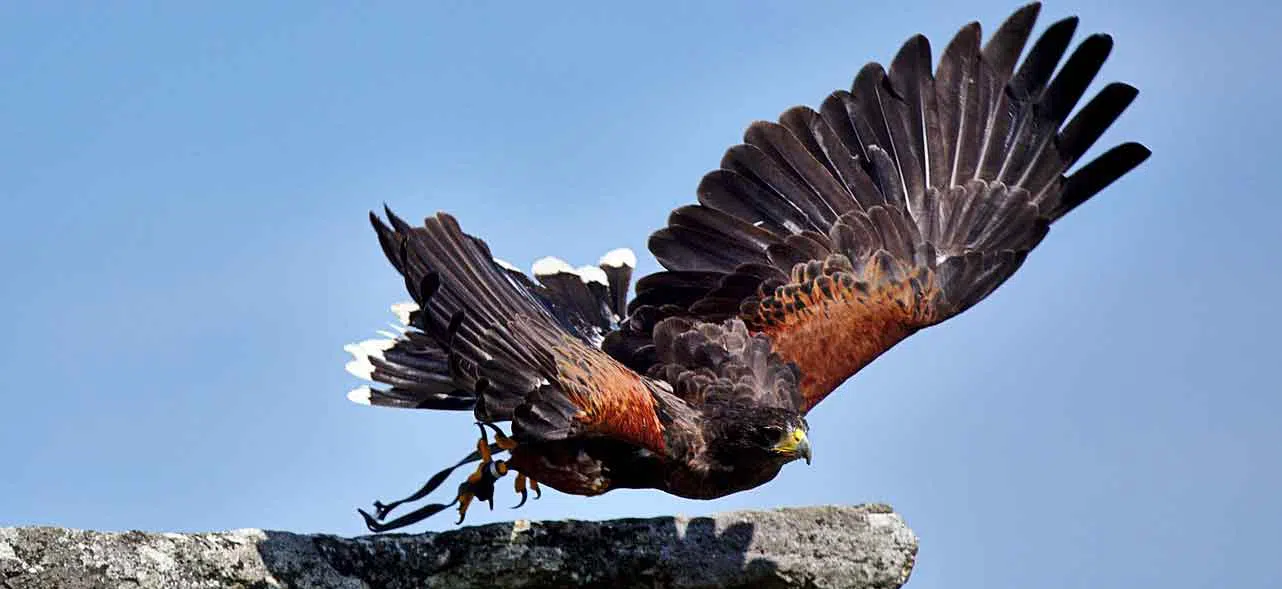
What is Falconry?
Falconry is the ancient art of hunting with trained birds of prey. It has been practiced for thousands of years in many cultures around the world. More recently, falconry is used for bird control, wildlife removal and abatement, It takes advantage of the natural relationship between bird predators and their prey. The predators - birds of prey, or raptors, are trained to scare away and chase pest birds. With a raptor in the area, the pest birds quickly learn the area is no longer safe. The pest birds become stressed and they quickly learn to avoid the area entirely.