 CA
CA US
US




In this article, we'll attempt to dispel some myths and answer most asked questions about whether one may keep, buy, or sell bird feathers. Spoiler alert: in most cases, the answer is no - you may not.
Let's first dive into a little bit of history to see why there are limits or outright bans on collecting, keeping, buying, or selling bird feathers.
A Feather in Your Cap
 It all began more than a century ago with the world's love of extravagant feathered hats. From European royalty to upper middle-class folks in the Americas, the ladies (and gentlemen!) donned the exquisite creations of the era's busy and talented milliners - and landed countless bird species on the brink of extinction. What started as a symbol of success, affluency, fashion sense, and elegance in the late 1800s ended up being an environmental crisis of epic proportions. Birds such as egrets, herons, and other exotic birds were hunted by the millions for their feathers and their demise was what sparked some of the world’s earliest wildlife protection laws.
Here's the Tea
Enter two Boston socialites: cousins Harriet Hemenway and Minna Hall. Outraged and mortified by the mass killing of egrets, the ladies launched a different kind of Boston tea party: During high tea, they educated their fellow high society friends and urged them to boycott feathered hats altogether.
Incidentally, their campaign gained rapid support and lead to the founding of the Massachusetts Audubon Society, one of the earliest conservation groups in North America. Their grassroots activism inspired sweeping change and helped birth the Lacey Act of 1900 which aimed to end illegal wildlife trade.
Modern bird conservation was shaped by these early efforts that lead to the creation of protective legislation and the first federal bird reserves down the road. Today, almost all native bird species are protected under the Migratory Bird Treaty Act (MBTA) of 1918 and that includes their plumage. This legislation became one of the strongest wildlife protections ever created in North America.
On To The Questions
Q: Can I keep feathers I found?
A: Generally speaking, no, you may not. The Migratory Bird Treaty Act makes it illegal to hunt, capture, sell, or even possess migratory birds or any part of them, including feathers, nests, or eggs. That means even feathers from molting or dead birds are off limits unless you have special permission. Exceptions exist for legally hunted game birds and Indigenous communities who use feathers for cultural or spiritual ceremonies.
Q; How can I get permission to keep feathers?
A: If you seek to keep or use feathers for scientific, research, or educational purposes, contact the Canadian Wildlife Services office near you. Permits are generally required for feathers from migratory birds, such as eagles, hawks, owls, and many songbirds
Q: Can I buy feathers?
A: Surprisingly, the answer is yes. You can legally buy various types of feathers for crafting, fashion, or commercial use, as long as they are sourced from domestic birds (like chickens, turkeys, ducks, geese) or permitted wild game. Specialized suppliers like United Feather & Flower Corp. in Hamilton/Mississauga and Turtle Lodge Trading Post along with craft stores such as Michael's offer bird feathers for sale.
Q: Can I buy feathers from Hawkeye?
A: No, we do not sell feathers of any kind. While we are permitted to have, keep, and use feathers, we are not allowed to sell them commercially. Reasons why we keep feathers and their purpose include repairing damaged feathers of our own birds of prey (also called imping).
Q: Can I buy feathers from Indigenous people or businesses?
A: As long as the feathers you want to purchase are from domestic birds - yes, sure. But if you're thinking eagle feather, then the answer is a definite no. And, no indigenous person or business would be willing to sell or gift an eagle feather to a non-indigenous person.
Q: What is the significance of an eagle feather?
A: In Anishnaabe culture and in fact in most tribes, the eagle feather is regarded a deeply sacred object representing a direct connection to the Creator. It acts as a messenger for prayers and a symbol of high honor, wisdom, and strength. The eagle is believed to be flying highest and therefore closest to the creator, and able to carry prayers with it. Receiving an eagle feather is a profound honor; it is often gifted for achievements, sacrifice, or bravery. One carrying an eagle feather is viewed as speaking truthfully and honorably. Eagle (and other) feathers are also used in smudge ceremonies. An eagle feather must not be given or gifted to a non-indigenous person.
 Q: Can I own art containing eagle feathers?
A: Again, unless you are an indigenous person, the answer is no. Buying, selling, or owning art with eagle feathers is generally limited to Indigenous peoples.
Q: Can I own and wear a hat with feathers in 2026?
A: Yes, you can. Many do as hats are still a staple at events such as the Kentucky Derby :) As long as the feathers did not come from a protected bird, fancy hats are just fine. Today's hat feathers are usually sourced from turkeys, chicken roosters, guineas, or geese and hand crafted (shaped, layered, and dyed).
Q: Can I buy and own goose feathers?
A: In Canada - yes. In the US it's a little more complicated. You'd have to prove that the feathers came from Canada and were collected during goose hunting season. There is no legal goose hunt in the U.S. ALL feathers have to be obtained legally.
In Conclusion
Most feathers are illegal to own, sell, or buy even if they were laying on the ground. The reason behind this is that it would be near impossible to prove that one 'found' a feather in their yard and if that were a legal argument, it might once again encourage the illegal hunting of birds for their plumage.
Come Feather-Watching at Hawkeye!
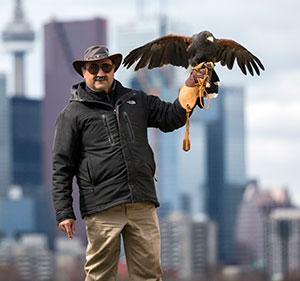
If you're all about admiring birds and their feathers, why not come and visit with Hawkeye's many birds of prey in a Falconry Experience over the summer, Owl Experience during the winter months, or an Eagle Adventure? Ask questions, learn, admire, and fly a bird of prey! It's loads of fun and we'd love to have you. Book online or call us at 416.429.5393 Monday - Friday.
